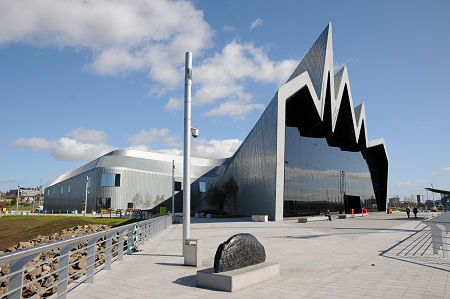
 Glasgow's Riverside Museum |
Glasgow & Clyde Valley cuts a swathe through west central Scotland and includes the following local authority areas: West Dunbartonshire, East Dunbartonshire, Inverclyde, Renfrewshire, East Renfrewshire, City of Glasgow, North Lanarkshire and South Lanarkshire. It thus extends from the largest city in Scotland to some of the country's most remote areas and, almost, to its highest village. For accommodation in the area see the links in the "See and Stay" menu above. See the map below for an outline of the area and links to surrounding areas.
It is difficult to explain the growth and the importance of Glasgow. It has never been a capital or a residence of Kings, it is on a site that was not easily defensible, and although on a major river it didn't have a natural harbour. But despite all this Glasgow had already been through two booms and two busts by the time it established itself in the 1800s as the second city of the British Empire and, with the rest of Clydeside, the shipbuilding capital of the world. It was also, by far, Scotland's largest city.
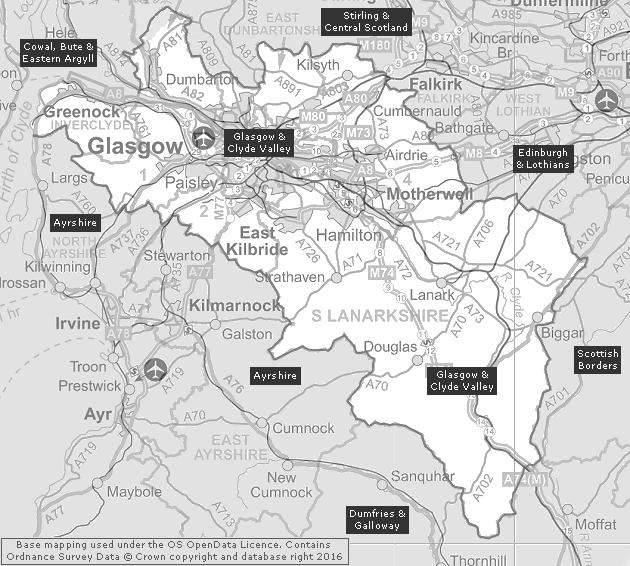 Glasgow & Clyde Valley, Showing Main Settlements & Connecting Areas |
Glasgow's origins lie with a Christian missionary called Mungo who established a church here. By AD600 St Mungo (also known as St Kentigern) was the Archbishop of the Kingdom of Strathclyde, whose Kings resided at Dumbarton Castle. It is usually thought that the name Glasgow comes from St Mungo's description of the community that grew up here as Clas-gu or "dear family".
Glasgow spent the next thousand years as an important ecclesiastical centre. This engine for growth stopped dead in its tracks with the coming of the Reformation in 1560, which although leaving Glasgow Cathedral miraculously unscathed, swept away the power structure of the existing Church in Glasgow and in Scotland more widely. Paisley Abbey, a few miles to the south-west, was less lucky. It had been badly damaged before the Reformation and has only been fully restored over the past 150 years. Modern Paisley developed on the abbey lands.
By the 1700s Glasgow was thriving as never before, with new wealth based on the lucrative trade, largely in tobacco, with the American colonies. Glasgow's second major slump came with American independence in 1775, which killed much of its trade overnight.
Glasgow's population increased tenfold during the 1800s. This spectacular growth was based on the development of heavy industries using raw materials from places like Motherwell, Wishaw, Hamilton, Airdrie, Coatbridge (complete with Summerlee, the superb Museum of Scottish Industrial Life), and Shotts in the central belt of Scotland. Of particular importance was the remarkable development of the shipyards along the length of the River Clyde, especially in Port Glasgow and Greenock. Clydeside suffered during the depression of the 1930s, but this was only a precursor to the eventual demise of the shipbuilding industry in the 1960s and 1970s.
After the second world war, housing was a key priority and many residents of the city's notorious inner city slums were moved out to peripheral estates, or to new towns like East Kilbride and Cumbernauld. Not far from Cumbernauld, and in the shadow of the hills that mark the northern edge of the central lowlands, are the much more established towns of Kirkintilloch and Kilsyth. Between them is the Bar Hill Roman Fort on the line of the Antonine Wall.
Today's Glasgow has in large measure recovered from this third slump, and has been referred to as the world's first post-industrial city. It has turned itself around painfully, slowly, and very unevenly, and still has some of the most deprived areas in Scotland. But no visitor to the city can fail to feel the vitality and energy with which it entered the third millennium.
More widely, Glasgow is home to a wide variety of attractions old and new. The city centre is famous for its shopping, and for its amazing collection of architecture. Gathered around Glasgow Cathedral you find a number of other attractions including Glasgow Necropolis, the St Mungo Museum of Religious Life and Art, which doubles as a Cathedral Visitor Centre, and Provand's Lordship, arguably the oldest house in Glasgow. On Glasgow Green, the oldest public space in the city, you find the magnificent People's Palace and Winter Gardens.
In the West End you find the superb Kelvingrove Art Gallery and Museum, the outstanding new Riverside Museum and The Tall Ship. Nearby Glasgow University is home to the Hunterian Museum and Hunterian Art Gallery.
On the south side of Glasgow are a range of attractions including, in Pollok Park, Pollok House and the Burrell Collection. Further east lie the town of Rutherglen, as well as Greenbank Garden and Alexander "Greek" Thomson's most famous domestic building, Holmwood House, while further to the west is Crookston Castle. Further south, on the edge of the Renfrewshire Hills, is the attractive village of Eaglesham.
To the east of the city attractions include the mighty Bothwell Castle overlooking the Clyde near Uddingston and the nearby David Livingstone Centre: while an unexpected find close to Junction 10 on the M8 is Provan Hall, the best-preserved medieval fortified country house in Scotland. Still more unexpected is the Museum of Scottish Country Life, on the edge of East Kilbride, arguably Scotland's most successful new town.
There are many fine hotels in and around Glasgow, and we have produced hotel and dining reviews for Mar Hall Hotel near Glasgow Airport and for Blythswood Square and Malmaison Glasgow in the city centre.
If you head downstream on the Clyde you come to Govan, long a centre of shipbuilding. Govan Old Church has a history dating back 1300 years, and is home to the magnificent Govan Stones, one of the best collections of early medieval sculpted stones in Scotland. Further down river you pass the town of Renfrew, served by the last remaining ferry across the upper reaches of the Clyde, the Renfrew to Yoker Ferry. In Port Glasgow you find Newark Castle, remarkably preserved and on a site that was until relatively recently surrounded by shipyards. Further still along the Clyde, past Greenock, you find Gourock, traditional ferry terminus for Dunoon offering services by both Argyll Ferries and Western Ferries. And around the corner of the Clyde Estuary is the attractive village of Inverkip, with its marina. Further round the coast is Wemyss Bay, the terminus for the ferry service to Rothesay on the Isle of Bute.
Further inland, the A737 links Paisley to the coast, and a series of towns lie along its route, including Lochwinnoch with the nearby Castle Semple Collegiate Church.
Six miles north-west of Glasgow is the affluent suburb of Bearsden, where you will also find the Bearsden Roman Baths. Nearby Milngavie is the start of the West Highland Way 95 mile long distance footpath to Fort William.
Further north-west is Loch Lomond, Scotland's largest loch by surface area. Its accessibility makes it a popular choice for day visitors and for weekends away from the city. Balloch, at the southern end of the loch is only a half hour drive from the centre of Glasgow and its Castle Country Park is open all year. Balloch pier is also home to the paddle steamer, Maid of the Loch, currently undergoing restoration, while nearby is the Loch Lomond Shores development. Not far away, and back on the River Clyde, is Dumbarton, with its magnificently located castle perched improbably on Dumbarton Rock. A couple of miles to the east is the attractive Bowling Harbour, at the western end of the Forth and Clyde Canal.
Follow the Clyde Valley upstream, south-east from Glasgow, and the main settlement you encounter is Lanark, where the river flows from the Southern Uplands to the Central Belt of Scotland. The town, like the river whose valley it overlooks, has one foot in the upland rural areas to the south, the other in the industrial heartland of Scotland to the north.
Lanark itself is an attractive town. St Nicholas Parish Church, though only dating back to 1774, is home to the world's oldest bell, cast in 1130. Lanark is perhaps best known for nearby New Lanark. This complex of cotton mills built along and powered by the River Clyde comes complete with its own village, still providing people with homes in the midst of a World Heritage Site.
The Clyde Valley passes through extremely attractive countryside north of Lanark. Other gems include secluded Craignethan Castle, on a bluff overlooking a tributary of the Clyde. North east of Lanark is the village of Forth, which developed around coal mining, and the nearby upland settlement of Braehead.
Twelve miles east of Lanark is Biggar, a traditional market town serving a large but sparsely populated hinterland. The town itself is home to some excellent museums. Among them is the outstanding Biggar & Upper Clydesdale Museum and the Biggar Gasworks Museum, home to Scotland's only surviving town gasworks. Near the centre of Biggar is the attractive Biggar Kirk, rebuilt in 1546. A little to the west of Biggar is Coulter Motte. In nearby Lamington there is a remarkable Norman arch forming part of the later St Ninian's Church.
North east of Biggar the main A702 road generally follows the line of the Roman road built to serve the Roman fort at Musselburgh. Further west lie the villages of Carstairs and Carnwath. On the edge of the latter is St Mary's Aisle.
South east of Biggar is one of Southern Scotland's finest viewpoints, the 2,334ft or 711m high Tinto. To its south you can see a broad swathe of the Southern Uplands, complete, in the distance, with the ribbon of the M74 as it starts to wind its way through the hills towards its eventual destination of the English border. To Tinto's west, just beyond the M74, is the ancestral home of the Black Douglas family, Douglas. The family mausoleum is housed in St Bride's Church in the village. Further north you pass Lesmahago and the remains of Lesmahago Priory en route to the attractive town of Strathaven, which stands on the A71 three miles south-west of Stonehouse. The main road through Strathaven is dominated by the ruin of Strathaven Castle.
The Lowther Hills, south-west of Abington and Crawford and west of the M74, offer some of the loneliest landscapes Scotland has to offer and are traversed by the Southern Upland Way long distance footpath. One point of entry is via the B740 road through Crawfordjohn. Another is the A702 heading south towards Dumfries, which is an excellent way to see a great deal of very little as you traverse the Lowther Hills. Nearby Leadhills is home to the Leadhills & Wanlockhead Railway.
Driving Tours: Much of the south and west of the area is included in our Lanark & Sanquhar Driving Tour.
|
|
|
|

|
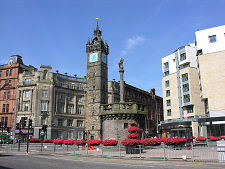 Glasgow: Tolbooth & Mercat Cross |
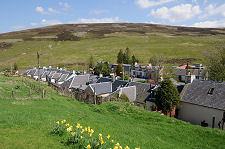 Leadhills in South Lanarkshire |
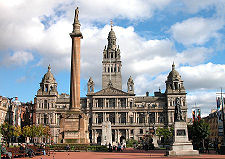 George Square and City Chambers |
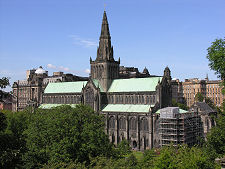 Glasgow Cathedral |
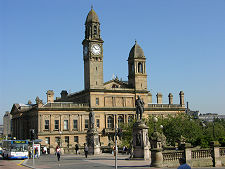 Paisley |
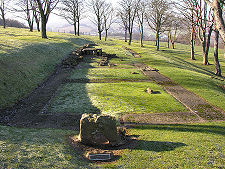 Barr Hill Roman Fort |
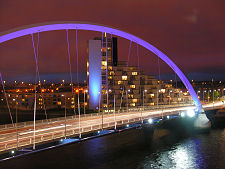 Finnieston or "Squinty" Bridge |
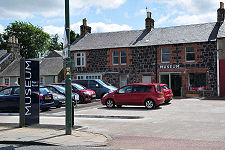 Biggar & Upper Clydesdale Museum |
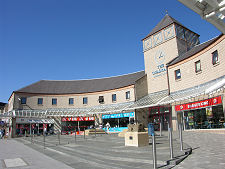 Coatbridge |
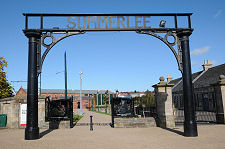 Summerlee Industrial Museum |
