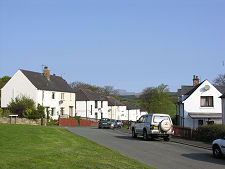
Looking Along Teith Road, with the Clock Tower on the Right |
The village of Deanston lies on the south bank of the River Teith a mile west of Doune. While Doune has a very long history, Deanston came into being in 1785 as a planned village providing accommodation for the workers at the newly built Adelphi cotton spinning mill.
The Adelphi Mill was designed by Richard Arkwright for the Buchanan brothers. It took its power from a mill-lade that brought water from a point upstream on the River Teith. After powering the mill's water wheels the water was discharged back into the river.
In 1799 Deanston was described by a visitor as: "a village inhabited chiefly by the labouring people belonging to the Adelphi cotton-work, where upwards of nine hundred persons are employed." After a serious fire, the mill was rebuilt on a much more ambitious scale during the 1820s, employing well over 1,000 adults and children.
During this expansion a bigger weir was built across the River Teith to divert water into what became one of the largest mill lades in Scotland: today part of this remains as, literally, a scenic backwater, but its sheer scale is comparable to the Caledonian Canal, built in the same era to transport ocean-going ships. The water from the mill-lade turned four 11m water wheels, which powered the machinery in a vast new spinning mill and weaving shed. At the same time more workers' housing was built in Deanston.
The Adelphi Mill achieved a small footnote in history from 1786 by being the first major industrial concern to produce its own coins and paper money for issue to its workers. This was designed to overcome a shortage of currency in circulation at the time.
The mill wheels at the Adelphi Mill continued to turn until 1949. Redevelopment and expansion of the mill in 1950 meant that other forms of power came into use but despite this - or perhaps because of it - the mill closed in 1965. Uniquely in Scotland, it was then converted into Deanston Distillery.
The distillery closed in 1982, but was purchased and reopened in 1990 by Burn Stewart, the company which also owns Tobermory Distillery on Mull. It remains in production today, and the vaulted weaving shed is used to mature whisky produced both here and at Tobermory Distillery.
A distillery, even a large one, employs far fewer people than a cotton mill, so Deanston's era as a company village came to an end in 1965. Today the lower parts of the village remain much as originally built, though newer housing has been added further up the south side of the River Teith valley. Another change since the move away from water power in 1949 has been the filling-in of the last hundred yards or so of the gigantic mill lade, a move apparently designed to provide larger gardens for some of the village houses.
Perhaps the most striking building in the village itself - apart from the mill - is the small clock tower. This was erected in memory of Lady Muir of Deanston, who died in 1929. Meanwhile, although Deanston itself was designed to house the mill workers, the mill owners wanted something altogether grander in scale. Deanston House was built in about 1820 on the southern edge of the village, and extended in 1883. Today it serves as a nursing home.
 Deanston Distillery and the River Teith |
|
|
|
Visitor InformationView Location on MapWhat3Words Location: ///gasp.glows.frames |
 Clock Tower |
 The Cottages |
 Village Streets |
 Village School |