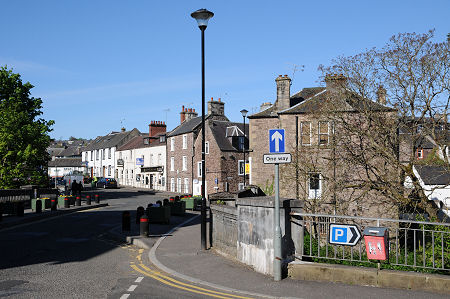
 Stirling Road and the Bridge over the Allan Water |
Dunblane lies some five miles north of Stirling on the Allan Water. A bustling and wealthy town, it comes complete with a charming centre and one of Scotland's most attractive cathedrals. Though often very busy, its character has been partly preserved by being bypassed by through traffic twice, first by a road built immediately to the east of the town centre, and then in 1993 by the dual carriageway A9 to the west, linking Glasgow and Stirling with Perth.
Today's Dunblane is what you would expect of somewhere whose obvious attractions are combined with easy access to most of Scotland's main centres of employment. Many more people live here than work here, and its railway services to both Edinburgh and Glasgow are well established commuter runs. And when you take the trouble to turn off the bypass, or perhaps that should be "both bypasses", you can readily see what draws them here.
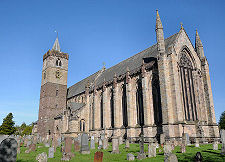
Dunblane is a town with an ancient history. A Roman road passed through en route to Perth, and it seems likely that a Roman fort (or "dun" in Gaelic) was built on the high ground now home to Dunblane Cathedral. This is said to have been chosen in around AD600 by St Blane for the site of an early monastery, giving rise directly to the name by which the town is now known.
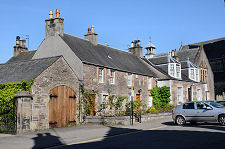
The first stone church was built on the site of what later became the Cathedral in about 1150. It was not the only church in the area: a very much smaller one lies just to its east. In the 1960s the row of old houses and cottages on the east side of the square overlooking the Cathedral, having only just escaped demolition, were converted into Scottish Churches House. This serves as an ecumenical centre and retreat.
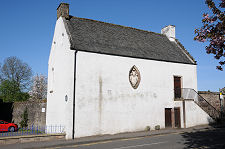
During conversion work, a single chamber barrel-vaulted stone chapel was discovered set into the rising ground behind the houses. This has been beautifully restored to serve as the chapel for Scottish Churches House and has a simplicity that makes a striking contrast with the grandeur of the nearby cathedral. It is tempting to suggest that this long forgotten chapel might have had some direct link with St Blane, but it is generally believed to date back to the 1200s.
Another name that features large in Dunblane's past is Robert Leighton, who was Bishop here during the 1660s. On his death he left his library of 1400 volumes to the town, together with funds to build a home for it. The library, now world-famous, remains in Dunblane following restoration work in the late 1900s.
Like many Scottish towns with access to the power afforded by fast flowing water, Dunblane saw a boom in textiles in the early 1800s. A woollen mill near the town centre was established, as was a silk-dyeing mill.
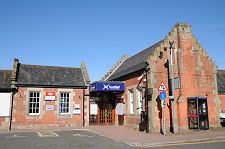
The arrival of the main line railway from Stirling to Perth in 1848 transformed the town, in part by the demolition of its brewery to make way for the station, but mostly because it allowed visitors to flow in, and commuters to flow out. Later it became the junction which connected the Callander and Oban Railway to rest of the network.
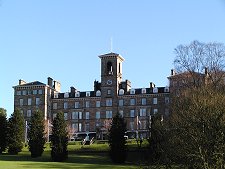
Dunbane's growth as a resort resulted in developments like the Dunblane Hydropathic Hotel, usually known as the Dunblane Hydro, which first opened its doors in 1878 and still enjoys magnificent views west from its lofty position on the east side of Dunblane.
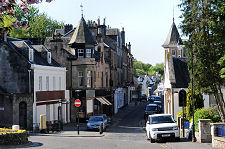
From a visitor's point of view, the main axis of interest runs along the narrow High Street, aligned almost north-south. Beyond the southern end is the dual carriageway Perth Road, which, unusually, provides much of the town's parking. Nearby is the railway station on Stirling Road. The High Street climbs away from the bridge over the Allan Water, hemmed in tightly and attractively by shops and cafes on both sides. As you reach the upper part of the town the High Street curves around on itself, leaving visitors to continue up The Cross as far as the cathedral precinct, which dominates the upper part of the town.
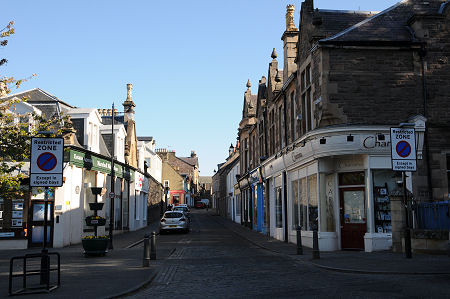 Early Morning View Up Dunblane High Street |
|
|
|
Visitor InformationView Location on MapWhat3Words Location: ///upon.reactions.vouch |
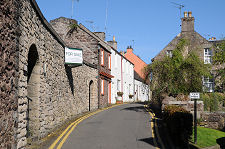 Bridgend |
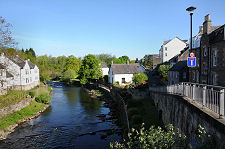 The Allan Water |
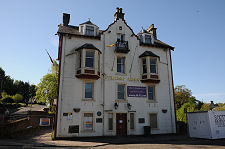 The Stirling Arms |
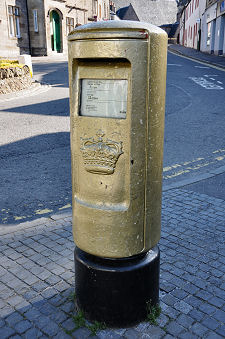 Sir Andy Murray's Gold Postbox |