 Kenmore, Seen Across the Eastern End of Loch Tay |
Kenmore is an extremely attractive planned village situated some six miles west of Aberfeldy on the A827. Its site is on what amounts to a promontory projecting into the eastern end of Loch Tay, formed by the loch to its south and west, and the River Tay to its north.
Kenmore as you see it today was built as a planned estate village by the Earl of Breadalbane in the years following 1755. It stood on the site of an earlier village which in medieval times may have been known as Inchadnie.
Another account suggests that Inchadnie was actually a distinct village which until 1550 stood beside a ford over the River Tay a little to the east. It was then removed to make way for the construction of the principle seat of the Campbells of Breadalbane, Balloch Castle, the predecessor of Taymouth Castle.
At the heart of Kenmore is "The Square", an extremely broad east west street lined with strikingly attractive (mainly) white harled buildings. The most imposing of these is the Kenmore Hotel, on the north side of the Square. This claims to be Scotland's oldest inn and carries a date of 1572. On one of the walls is a poem written, actually onto the plaster of the wall itself, by Robert Burns during a visit in 1787. The Kenmore Hotel oozes character with distinctive rooms and a striking front entrance supported by black painted tree trunks. At the end of the row of cottages on the opposite side is the village shop and post office.
The parish church built to serve Kenmore in 1760 reused parts of an earlier church built in 1669. It stands at the west end of The Square on a site that drops steeply on two sides to Loch Tay. Another feature that was important to the success of the newly redeveloped village was the construction in 1774 of the seven arch Kenmore Bridge, built across the River Tay immediately to the north-west of the village, where the river flows out of Loch Tay. It is said that £1,000 towards the cost of its building was donated by George III.
The main road through the village uses the western two thirds of The Square before turning south to run along the east end of Loch Tay. The quieter eastern end of The Square is dominated by the elaborate stone gateway leading to the estate of Taymouth Castle. Taymouth Castle itself is vast and imposing. It was built between 1802 and 1842 on the site of the earlier Balloch Castle and is said to contain some of the most opulent interiors from the era anywhere in the UK.
Taymouth Castle passed through a variety of uses during the 1900s. In 2004 work began on a project to convert it into a luxury hotel. Progress was sporadic and for a number of years the future of this magnificent building seemed very unclear. More recently it has been reported that the project is back on track, and the golf course, which opened in 1925, has been closed for remodelling and upgrading.
Kenmore makes much of its waterside location. Piers and moorings line the side of the loch to the south of the centre of the village. Meanwhile the village has extended to the north, to the far side of the River Tay, where attractive new development has appeared in recent years.
For those more interested in the hills than the lochs, Kenmore is superbly located, offering convenient access to Glen Lyon, to the hills of Breadalbane and, north, to Schiehallion and beyond. Readily visible from the lochside at Kenmore is Ben Lawers, towering over the north side of Loch Tay, and falling only marginally short of the magic 4,000ft mark.
Just out of the village along the south Loch Tay road, is the superb Scottish Crannog Centre. The key exhibit is an authentic reconstruction of a Iron Age crannog, perched above the loch on stilts. Crannogs, from the Gaelic word crann, meaning tree, were built on an artificial rock island with timber posts and struts supporting a hut above high-water level. They were to be found on many lochs, including Loch Awe and Loch Earn as well as Loch Tay, from prehistoric times up to the 1600s.
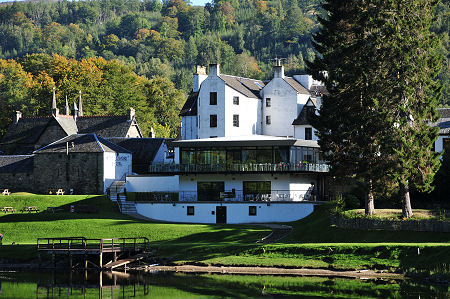 The Kenmore Hotel Seen Across the River Tay |
|
|
|
Visitor InformationView Location on MapWhat3Words Location: ///under.hockey.drawn |
 The Post Office |
 The Orphanage |
 Approaching Kenmore from the South |
 Taymouth Estate Gateway |
 Taymouth Castle |


