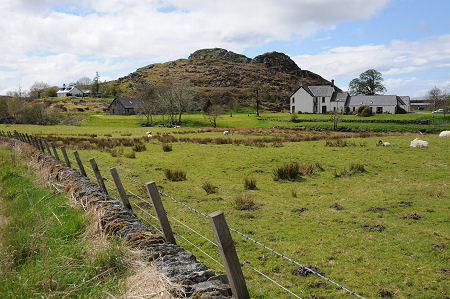
 Dunadd from the East |
A few miles north of Lochgilphead and south of Kilmartin on the banks of the River Add is a 175 feet high rocky outcrop. The main A816 lies just a few hundred yards to the east, but if passers-by notice anything, it is probably more the small collection of white buildings at the foot of the outcrop.
This is Dunadd. It is difficult to believe today, but between AD500 and AD900 this was one of the most important places in what has since become Scotland. The original Scots were migrants from Ireland who from about 500 settled across Argyll in ever greater numbers, founding the Kingdom of Dalriada. Dunadd was the capital of the kingdom and was the place where its Kings were anointed.
From this foothold the Scots eventually absorbed their much longer-standing neighbours, the Picts. By 843 Kenneth MacAlpin, King of the Scots of Dalriada, had also become King of the Picts, and in 850 pressure from Viking raids caused the conjoined Kingdom of Alba to move its centre from Dunadd to Scone, near Perth. Dunadd's days of glory were over.
It takes a little imagination to work out today what Dunadd must have been like in its days as the capital of Dalriada. The site has been excavated by archaeologists on three occasions, most recently in 1981, and as a result a fair amount is known about it. It originally had four lines of walls at different levels. In overall layout it almost echoed of the motte and bailey castles that the Normans were to introduce centuries later, with outer defended areas around a higher stronghold.
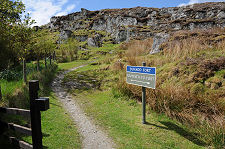
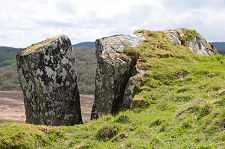
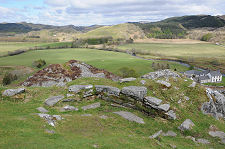
Today's visitor follows a path from the car park past the modern buildings at the foot of Dunadd and up through the lower levels of the outcrop. The route is a mild scramble in places, and boots are recommended. A rocky defile on the way up, even without the walls that would once have been added to it, show just how easily defended this place must have been. And as you climb to the top of the fortress above the defile, you can see below you the shape of the lower terraces.
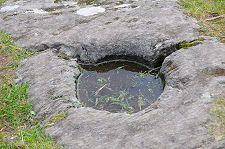
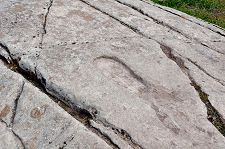
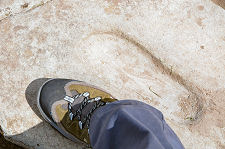
Visitors come closest to understanding the real significance of Dunadd once they reach the upper part of the outcrop. Here you can find a partial stretch of original wall from the fortress. There may not be much of it, but suddenly you realise you can touch something that Kenneth MacAlpin and his predecessors might have touched. Still more immediate are the rocky slabs at the summit. One of these contains a carved bowl whose purpose is unknown. But nearby is another larger slab, holding an imprint of a foot carved into the rock. It is thought that, following Irish tradition, the King of Dalriada was inaugurated by placing his foot into the rocky imprint. As you can today: and suddenly Dunadd begins to come to life.
Also nearby is some inscribed ogam text (an alphabet of straight lines), whose meaning is unknown, and a carving of a boar, now repeated rather more clearly on a slab of rock in the garden of one of the houses at the foot of the fortress.
Dunadd today forms part of the much wider landscape of Kilmartin Glen, full of relics of even earlier ages, and much of the glen can be seen from the summit of the fortress. But Dunadd stands out, both in scale and in its origins, and for anyone interested in seeing the home of the very first Scots, the climb to its summit a must. Dunadd is cared for by Historic Environment Scotland.
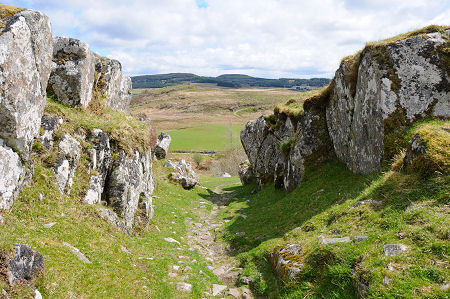 Looking Down the Rocky Defile |
|
|
|
Visitor InformationView Location on MapGrid Ref: NR 837 936 www.historicenvironment.scot HES: Dunadd Web Page Open all year and admission is free. What3Words Location: ///title.traffic.adjuster |
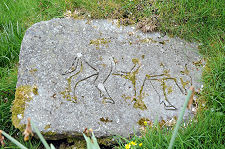 Copy of the Boar Carving |
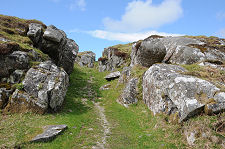 Looking Up the Rocky Defile |
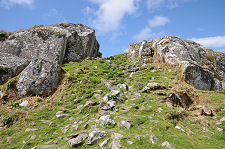 Climb to Upper Part of Dunadd |
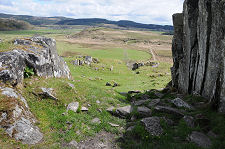 Upper Defile |
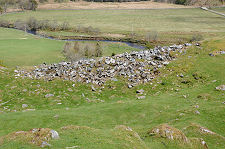 Traces of a Lower Rampart |