 The Rotunda at the Battle of Bannockburn Visitor Centre |
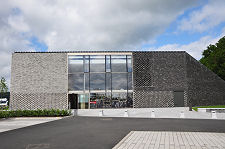
On the southern edge of Stirling is the Battle of Bannockburn Visitor Centre, run by the National Trust for Scotland. Here, and in the neighbouring parkland, Scotland commemorates, and to a degree celebrates, what most people view as the most significant victory won by Scotland over an invading English army. The Battle of Bannockburn took place on 23 and 24 June 1314.
It marked a turning point in the Wars of Independence between Scotland and England: cementing King Robert the Bruce's grip on Scotland; weakening Edward II's grip on England; and, arguably, deferring the Union of the Crowns of England and Scotland by nearly three centuries.
The general background to the Battle of Bannockburn is clearly established. The starting point was the accidental death of King Alexander III of Scotland in 1286. When his only heir, his young granddaughter, Queen Margaret, Maid of Norway, then died while sailing back to Scotland from Norway, it left Scotland torn between rival factions.
Inviting King Edward I of England to adjudicate between the competing claims for the Scottish crown probably seemed the only way to avoid civil war, but turned out to be inviting the fox into the henhouse. The complex Wars of Independence that followed saw Edward I fully justify the nickname of "The Hammer of the Scots" until his death in 1307.
Robert the Bruce, or Robert I, had crowned himself King of Scotland in March 1306. The death of Edward I gave Robert a breathing space of several years, during which he sought to consolidate his hold on power in Scotland in the face of the largely ineffectual efforts of Edward II of England and, initially at least, the much more dangerous opposition of his Scottish enemies.
By November 1313, Robert's long and brilliant campaign as a guerilla leader meant that the English controlled only one stronghold in Scotland, Stirling Castle, and this was under siege by forces led by Robert's brother, Edward Bruce.
Without Robert's knowledge, Edward Brucemade a deal with the English Constable of the castle, Sir Philip Mowbray, that if an English army had not arrived to relieve the castle by 24 June 1314, the castle would surrender, so making an aggressive siege unnecessary. Robert was not happy: he was deliberately avoiding the head on confrontation with an English army his brother's deal had now made unavoidable.
Edward II of England hastened to assemble an army of some 18,000 men: probably the largest English army (of many) to invade Scotland. They gathered in Berwick on 10 June 1314 and headed north. Late in the afternoon of Sunday 23 June the vanguard of the English army, following the old Roman road from Falkirk to Stirling, arrived at the ford over the Bannock Burn, a couple of miles south of Stirling. On the far side, in the New Park in which the Battle of Bannockburn Visitor Centre stands today, a Scottish army of some 6,000 awaited them.
The English vanguard attacked immediately, discovering to their cost that the Scots had placed concealed anti-cavalry ditches across the obvious line of approach. But one knight, Henry do Bohun, did manage to mount a personal attack on Robert, which Robert fought off with an axe. A second English attack, which tried to outflank the Scottish forces via the low lying ground to the east, was also repulsed when it encountered a Scottish schiltron, a formation of spearmen trained to present attackers with an impenetrable barrier of spearpoints.
The main battle took place the following day, on 24 June 1314. Over the years, there has been considerable controversy over the exact location of the second day's fighting, though archaeological investigation undertaken in advance of the 700th anniversary seems to have largely resolved the issue, and most now believe it took place in the location shown on Ordnance Survey maps. The Scots seem to have spent the night on a plateau known as the Dryfield, half a mile north-east of the Visitor Centre, while the English, needing water for their many horses, forded the Bannock Burn and occupied a low lying area a further three quarters of a mile north-east known as The Carse of Balquhidderock, bounded by the Bannock Burn to the south-east and the Pelstream Burn to the north. Separating the two armies was the steep side of the plateau, now known as Balquhidderock Wood, and some of the low lying carseland.
It seems likely that Robert the Bruce only decided to attack the much larger English army after hearing overnight from a defector, Alexander Seaton, that morale in the English camp was very low following their setbacks on the first day and because of arguments between Edward II and his senior commanders. Whatever the reason for his decision, very early the next morning the Scottish schiltrons emerged from the trees at the foot of Balquhidderock Wood, knelt briefly in prayer, and then advanced steadily on an English army that was forming itself up to attack to the north, towards Stirling Castle, rather than defend against a Scottish attack from the west.
Attacks by English mounted knights on the advancing Scots were repulsed, and the small contingent of Scottish cavalry prevented the English deploying their archers effectively. The Scottish advance was unrelenting, and the English army was simply rolled back on itself, into the narrowing and ever more congested area between the Bannock Burn and the Pelstream Burn. Most of the English tried to escape the way they had come, by crossing the Bannock Burn, but in the panic of a rout, may died in the attempt. Edward II only just escaped after the battle: most of the English knights did not.
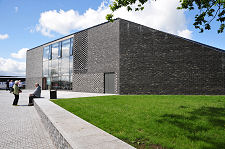
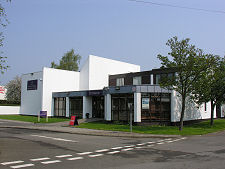
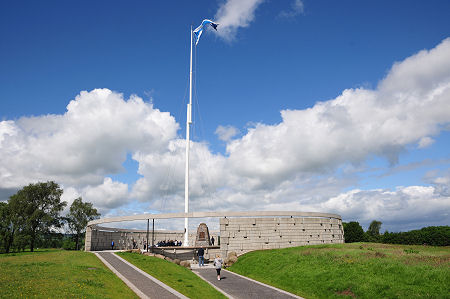
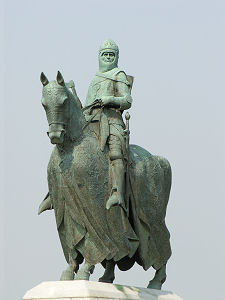
A heritage centre was built at Bannockburn in the late 1960s, close to what was traditionally believed to be the site of the main battle. This closed in 2012 to allow the building of the Battle of Bannockburn Visitor Centre you see today. At the same time the Rotunda, standing in the nearby park, and the fine mounted statue of Robert the Bruce were renovated to coincide with the 700th anniversary of the battle.
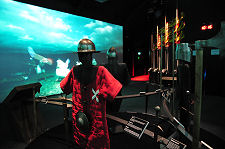
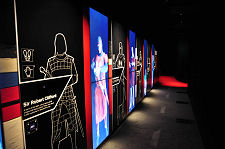
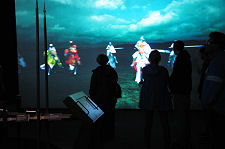
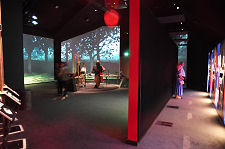
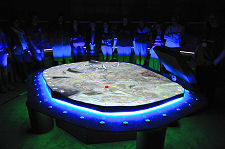
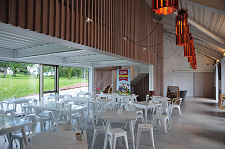
The new Visitor Centre which opened in early 2014 is home to a reception area and cafe, but its main focus is a remarkable 3D audio visual auditorium, which surrounds visitors with huge screens and places them very much in the heart of the action as the story is told. Backing this up is the Battle Room, in which the story of the battle is told across an interactive recreation of the landscape of the day; and on which groups can try their hand at fighting the battle. The gleeful enthusiasm with which a group of local schoolchildren greeted the news that they were to act as Edward II during our visit was remarkable.
There may now be fairly general agreement about the location of the Battle of Bannockburn, but opinions continue to differ about its true importance. It certainly paved the way for the Treaty of Edinburgh and Northampton in 1328, in which the Regency of Edward III renounced English claims over Scotland: albeit briefly, because Edward III overturned the treaty in 1333. English armies were to invade Scotland at intervals for another two centuries. And whatever might have been gained in 1328 was thrown away in later ill-advised adventures by Scottish kings, most notably James IV's unnecessary foray into England in 1513 in which the Scottish ruling class was effectively annihilated by the English at the Battle of Flodden.
Whatever else it achieved, the Scots' victory at Bannockburn did inspire the writing of the song now considered by many to be Scotland's National Anthem: Flower of Scotland.
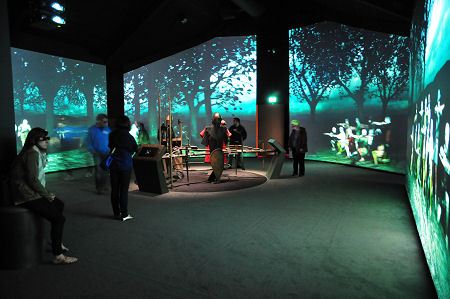 The Main Auditorium at the Battle of Bannockburn Visitor Centre |
|
|
|
Visitor InformationView Location on MapGlasgow Road, Stirling, FK7 0LJ. Tel: 01786 812664. Grid Ref: NS 797 905 Bannockburn Website Opening Hours Admission Accessibility What3Words Location: ///pets.token.shout |
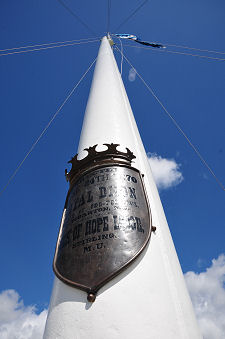 The Central Flagpole |
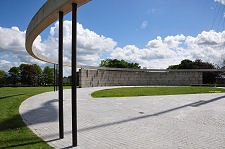 The Rotunda |
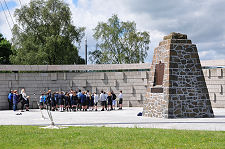 Bringing History to Life |
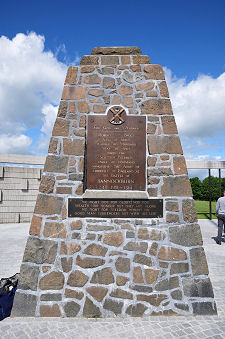 The Memorial |
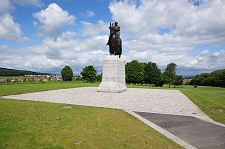 Statue of Robert the Bruce |
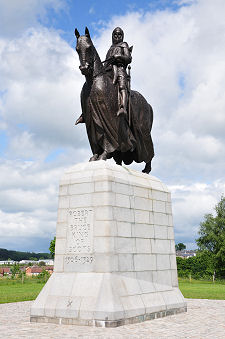 Another View of the Statue |
 The Statue Prior to Restoration |