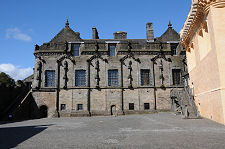
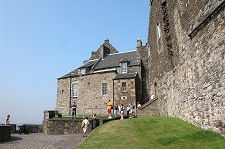
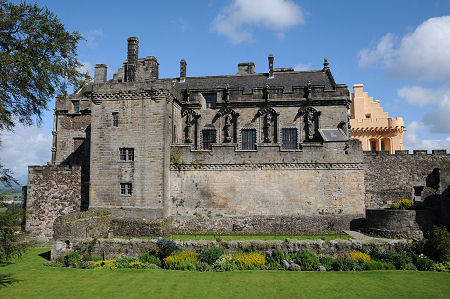
 The Palace from the Garden |
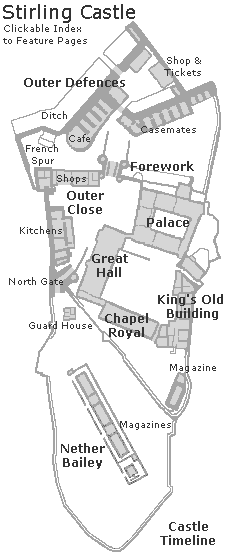
On 1 January 1537 James V married Madeleine, daughter of the King of France. Her ill health led to her death in July that year, and in 1538 James returned to France to marry Madeleine's adopted sister, Marie de Guise.
Marriage gave James V an accommodation problem at Stirling Castle. The King's apartments were in what is today called the King's Old Building, built by James IV. James IV probably also built Queen's apartments, but James V wanted something to show that Scotland could match the best he had seen in France.
The result was the Palace at Stirling Castle. Work began in about 1538 and it is unlikely that James saw it in its complete form by the time of his death in December 1542, just six days after the birth of his daughter, Mary Queen of Scots in Linlithgow Palace.
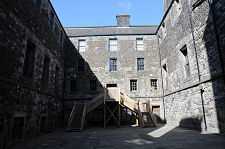
Completion of the Palace at Stirling fell instead to James' widow, Marie de Guise, and the resulting building is both remarkable and spectacular. The Palace is in the form of a hollow square.
At its centre is the paved area that has become known as the Lion's Den. The name probably comes from the importance of the lion in Scottish heraldry. An alternative theory that a lion given to James V in France in 1537 was housed here seems unlikely.
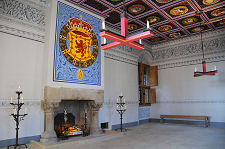
It comes as a surprise to discover that such an imposing building was designed around just six main rooms. The King and Queen each had a matched range of three rooms. Each had a large and fairly public room, the Outer Hall, in which a wide range of functions took place. Passing beyond this brought a more restricted circle of courtiers and others to the smaller Inner Hall, where audiences were granted with the King or Queen.
The third room in each suite is the Bedchamber. Despite the name, and despite the presence of a bed, these were also rooms were business could be transacted, albeit only with the King's or Queen's most trusted inner circle of advisers. The graded series of rooms served to sift out different layers of society: and of course visitors had first to gain access to the castle itself and then to the Palace.
The Queen's lodgings are contained within the south range of the Palace, with her Bedchamber occupying the south-east corner of the building. Linked to it in the east range is the King's Bedchamber, while his Inner Chamber occupies the north-east corner, and his Outer Hall occupies much of the north range of the Palace. Both bedchambers had private rooms attached. These "closets" probably comprised a private study, a comfortable bedroom and the en suite. Those attached to the King's Bedchamber still exist, overlooking the Lion's Den.
In June 2011 the Palace reopened to the public after a restoration project managed by Historic Environment Scotland that had taken some five years and cost £12 million. The result is utterly magnificent: and ensures that the Palace is now central to the visitor experience at Stirling Castle.
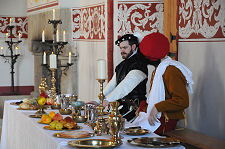
Today's visitor sees the Palace as it is believed to have been in the years following the death of James V, when Mary de Guise ruled Scotland as Regent for the infant Mary Queen of Scots. The rooms in the King's lodgings have been stunningly decorated, but are left largely unfurnished with the exception of a fascinating bed frame in the King's Bedchamber. As you wander through the Palace you are likely to encounter re-enactors playing the parts of characters ranging from the Palace Accountant to the Queen and helping bring the building to life through skillful interaction with visitors.
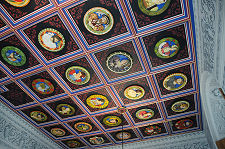
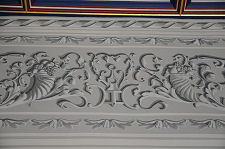
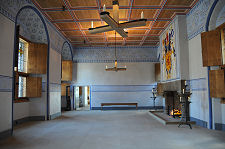
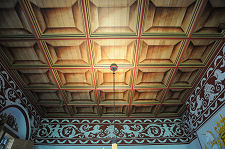
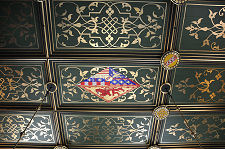
In many ways the King's and Queen's Outer Halls reflect one another well. Both are beautifully decorated, and throughout the Palace much use has been made of grisaille paintwork, where paint has been applied in a way that implies the three dimensional effects of ornate plasterwork or woodwork. The King's Inner Hall exhibits this effect most clearly, but here it tends to be overshadowed by the "Stirling Heads", which together form one of the most outstanding aspects of the original decor of the Palace.
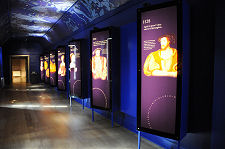
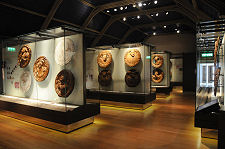
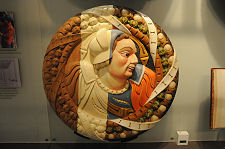
These are a series of 37 beautifully carved wooden heads laid into the ceiling of the King's Inner Hall. Their subject matter was seen as highly significant at the time, and combined real people, historical figures and mythical heros. There is now an excellent exhibition about the Stirling Heads on the upper floor of the south range of the castle. Here you can see many of the original heads. Those used in the restored ceiling are faithful copies, complete with the strikingly coloured painted finish believed to have been applied to the originals when the Palace was built.
And speaking of colour, one of the things that immediately strikes most visitors to the Palace is the bright, even gaudy, decor and detail. This was an age in which most people's lives would have been exceedingly drab: and one of the ways that the wealthy and powerful could set themselves apart was by extravagant use of expensive colour. At the Palace the effect is slightly over the top to modern eyes: it must have been simply stunning to those who saw it in the 1540s.
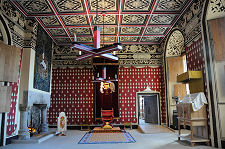
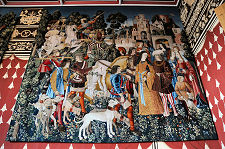
Many visitors find the two most impressive and evocative rooms in the Palace to be the Queen's Inner Hall and Bedchamber. Each is furnished as it would have been during Mary de Guise's Regency and the result is superb. In the Inner Hall the focus is on the understated canopied regal chair at the east end of the room. It takes a little while to begin to appreciate the real wonder of this room, the large tapestries depicting "The Hunt of the Unicorn" which hang at high level around the room. Each tapestry takes between two and four years to produce, and work to complete the set of seven will continue until 2013 in the Tapestry Workshop in the castle's Nether Bailey.
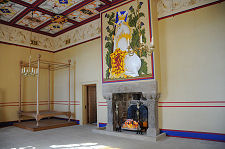
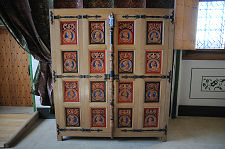
The Queen's Bedchamber is richly hung with drapes, and the furniture includes a beautiful four poster bed and a table and chair in front of the fireplace in the corner. These, like the linen cupboard, altar and wooden chest in the room have been lovingly recreated by skilled craftspeople, and the attention to detail and sheer love with which the interiors have been recreated add much to the joy of visiting the Palace.
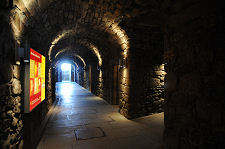
Beneath the palace, a stone arched tunnel which can be reached from the Outer Close or the Lion's Den gives access to the Palace Vaults, where younger visitors can take part in activities around themes such as jesters, musicians and tailors. Here, too, is the Access Gallery, which provides information about parts of the castle which may not be accessible to all visitors because of stairs.
The magnificence of three of the Palace's ranges does not extend to its fourth, the west range. At ground level this is formed by the West Gallery, a corridor linking the King's and Queen's Outer Halls to one another, and to one of the entrances of the Palace at the corner of the Inner Close. This corridor also gives access to the west side of the Lion's Den, and to an open area with spectacular views west now called the Ladies' Hole.
But the outer face of the west range is far from grand. There are accounts of a west range of the Palace in a state of collapse in 1583. But it seems unclear whether the Palace was simply left unfinished on this side after James V's death; whether it was finished and parts subsequently slipped over the edge of the castle rock cliffs; or whether the older buildings into which the southern and possibly the western sides of the Palace were fitted later collapsed.
In 1700 major alterations were made to the Palace to insert a floor of accommodation for the Castle Governor in what had been the roof. The original grand entrance to the Palace was reduced in size to make room for stairs leading up to the Governor's apartments. Later in the castle's life the Palace was used for military accommodation, though without the further extensive alterations suffered by the Great Hall and Chapel Royal. Slightly more recently what is now the King's Outer Hall served as a cafeteria, and until the restoration project began the Queen's Outer Hall was a function room.
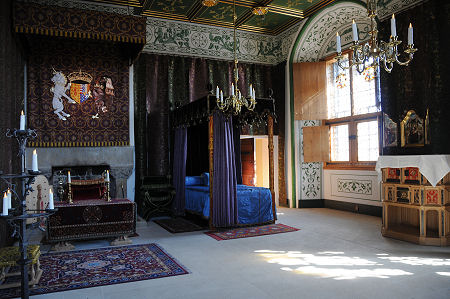 The Magnificently Furnished Queen's Bedchamber |
|
|
|
Visitor InformationView Location on MapFull information can be found on our Stirling Castle Main Page. What3Words Location: ///trim.judge.caring |
Stirling Castle In Fiction
|
 Hide and Seek by Ken Lussey (26 May 2023).
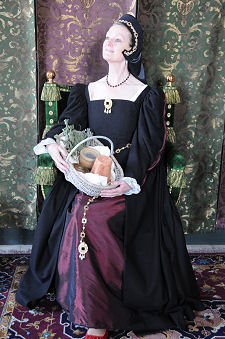 The Queen Holding Court |
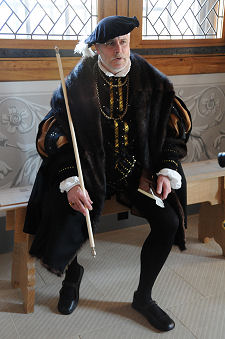 The Palace Accountant |
 Entrance to the Stirling Heads Gallery |
 The Stirling Heads Gallery |
 Painting the Replica Heads |
 The Palace Vaults |
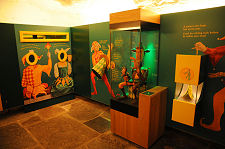 The Life of a Jester |