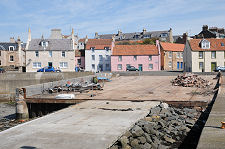
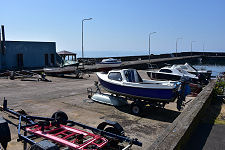
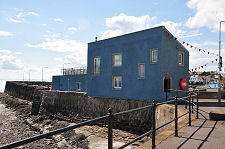
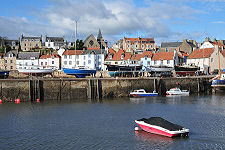
 The Eastern End of St Monans Harbour |
St Monans is one of the chain of pretty fishing villages that line the north shore of the Firth of Forth in what is known as the East Neuk of Fife. Lying between Elie and Pittenweem, St Monans offers an extensive historical core running behind the harbour, backed by newer development as you move inland.
St Monans has an ancient history. A village called Inverie existed here as far back as the 800s. In about 875 St Monanus or St Monan was buried at a shrine here and the village was renamed St Monans. Accounts differ about his background.
One story says he was a Scottish saint killed here by the Norse. Another says he was an Irish bishop who lived in the 500s, and that St Monans was founded when his relics were interred here. Yet another that he was an Irish missionary who came to this part of Fife in 832, before being killed by Danes in 875.
Whatever St Monan's origins, the village named after him had become a significant fishing port by the 1200s. The shrine that had been built to mark St Monan's burial was developed into a church between 1265 and 1267, standing right behind the beach at the west end of the village. The church was extensively rebuilt between 1362 and 1370 during the reign of David II, and many feel that much of the building you see today dates back to this time. (Continues below images...)
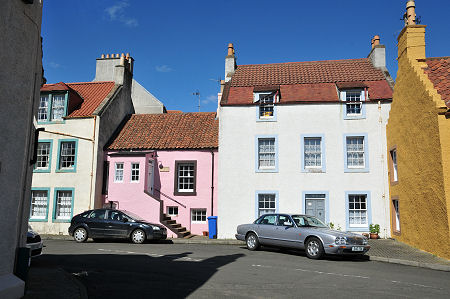 Cottages |
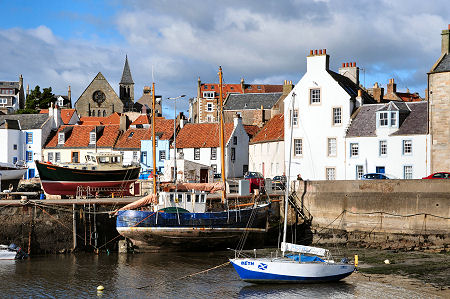 St Monans from the Harbour |
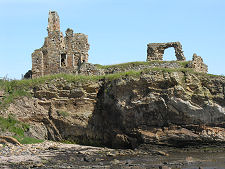
South west of St Monans, the coast path passes the remains of two castles. Newark Castle is the most striking, with substantial (if very precarious) remains standing on top of the crumbling cliffs. Like Ardross Castle, whose much lesser remains can be found overlooking the shore a little nearer Elie, its origins probably also date back to the mid 1200s.
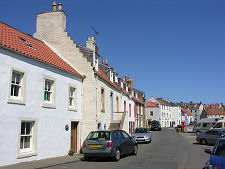
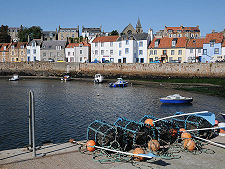
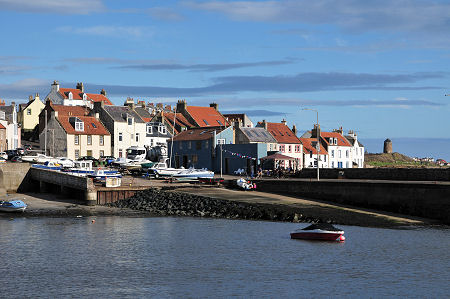
St Monans' heart is "The Shore": the road that runs alongside the harbour, divided into West Shore, Mid Shore and East Shore. This is lined by a spectacular selection of the beautiful cottages, houses and grander buildings that so typify the East Neuk fishing villages. White harled buildings mingle with those in their natural stone finish, while grey slated roofs form patterns with those topped off by red tiles imported from the Netherlands.
St Monans has three piers. The original one, built in 1596, still stands as the central of today's piers. The eastern pier was added in 1865, and the western pier in 1900 at a time when over a hundred fishing boats still sailed from St Monans. Today the number is, sadly, vastly reduced.
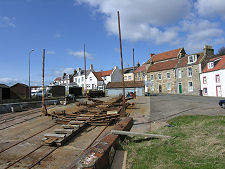
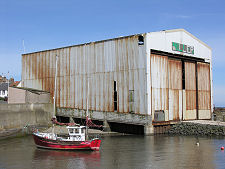
The landward end of the eastern pier used to be home to the large shed used by the shipbuilders JN Miller & Sons. Miller's closed in 1992, bringing to an end over 200 years of shipbuilding in the village. Among the last ships built here were the CalMac ferries MV Loch Tarbert and MV Loch Buie. The shed itself was demolished in late 2009, and its site has since been used as a boat park.
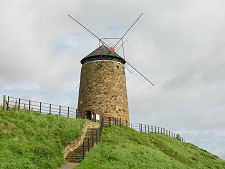
St Monans' industrial past extended beyond fishing and shipbuilding. At one point the harbour was used to export locally extracted iron ore, while a few hundred yards to the east of the village is another industrial relic. St Monans Windmill and the traces of nearby buildings are all that remain of a once thriving (if short lived) centre for salt production, in which sea water was evaporated over fires stoked with locally mined coal. These are some of the best preserved relics of an industry that once lined both shores of the Firth of Forth.
You can read the full text of the chapter about St Monans in D Hay Fleming's 1886 book: Guide to the East Neuk of Fife.
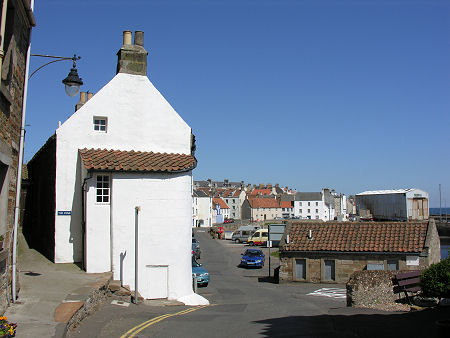 Looking Along West Shore, With Miller's Shed in the Distance |
|
|
|
Visitor InformationView Location on MapWhat3Words Location: ///relax.lighters.decimals |
St Monans In Fiction
|
 The High Road by Ken Lussey (15 September 2023).
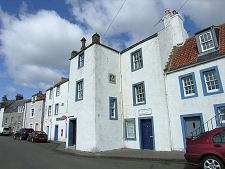 The Anchorage |
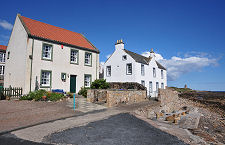 East Shore |
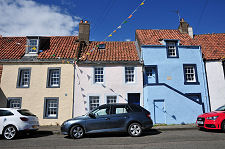 Harbourside Cottages |
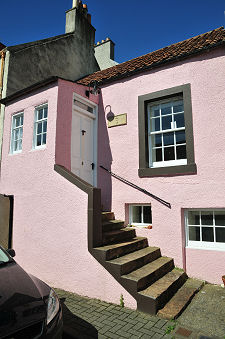 First Floor Entrance |
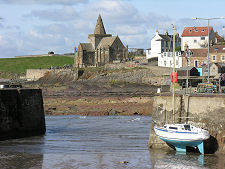 The Church from the Harbour |
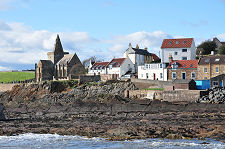 West End and Church |
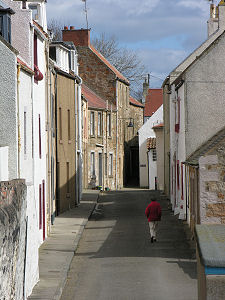 West End |