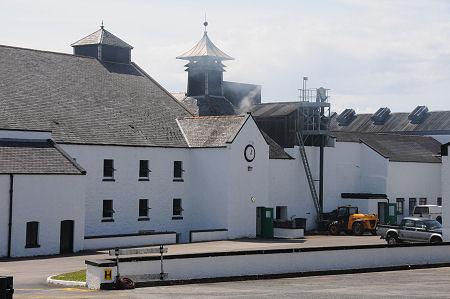
 Very Peaty Smoke Emerging from a Pagoda at Laphroaig |
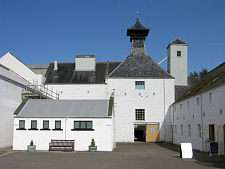
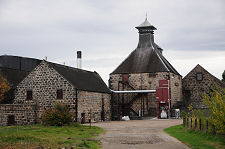
The pagoda which tops off the kiln and allows it to vent has become the emblem of the malt whisky distillery, which is a little ironic since the number which operate their own maltings, and so their own kiln, has shrunk dramatically. Three of those that do are on Islay: Laphroaig, Bowmore, and Kilchoman. Two more are on the mainland: Balvenie in Speyside and Springbank in Campbeltown. And another is in Orkney: Highland Park. The number is likely to increase as a number of new distilleries commence operation, which would be excellent news.
So if you want to see a kiln in operation, your best bet is at one of these distilleries. If you want to get a really close view, however, you can do no better than at Dallas Dhu. This is a disused distillery maintained by Historic Environment Scotland near Forres. It serves as a living, but non-operational, museum for Scotland's distilling heritage and as a result allows views of parts of the process normally too hot or too smoky to approach.
The kiln takes as its starting point the still germinating green barley from the floor maltings of the distillery, which by this point has a moisture content of around 43%. This is fed up to a mesh floor in the upper part of the kiln where it is laid as a blanket, heated by the furnace below and permeated by its smoke. (Continues below image...)
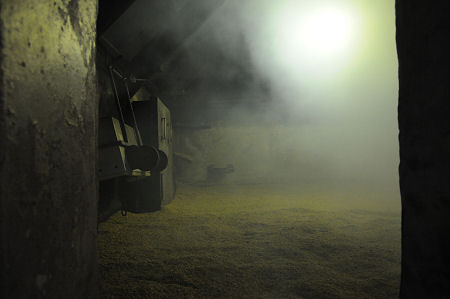 The Very Peaty Smoke at Laphroaig Distillery |
The kiln has three purposes. The first is to stop the germination of the barley at the optimum time by heating it. The second is to dry the green barley until it has a moisture content of about 4.5%, which is dry enough to allow it to be milled. And the third purpose, in some cases, depending on the character of the whisky the distillery is seeking to produce, is to add a peaty smokiness to the flavour of the malt, and as a result to the whisky that is then produced from it.
The last of these is much misunderstood. It is probable that in the days when just about every farm had an illegal still, most malted barley was dried over the central peat fires often used for everyday heating and cooking. The result must have been a flavour far too extreme for modern tastes (and the tastes of many at the time). But when you lived in an atmosphere of peat smoke anyway, you probably didn't notice: especially if you drank your whisky, as all but the well-off did, fresh from the still.
Against this background it is hardly surprising that blended whisky came into vogue in the 1800s. This tempered the excesses of most malt whiskies of the period with blander and more predictable (and cheaper) grain whiskies. It took over a century for most people to rediscover the wonderful truth that properly matured malt whisky was actually drinkable (and, as many believe, actually preferable) on its own.
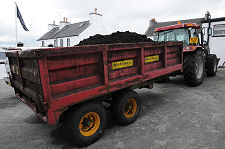
These days the furnaces in distillery kilns are fuelled mostly by coke (or in some cases oil) with peat added to the fire, if at all, for measured periods designed to give the barley a specific degree of peatiness.
After about 40-60 hours in the kiln, the malted barley has become light and relatively friable and is ready to move through to the milling process where it is broken down into grist. At this point we return to a part of the distilling process that takes place in most modern distilleries. Even those who rely on industrial maltings for their malted barley usually undertake the milling of it themselves, before feeding it into the next stage of the process, the mash tun.
Assuming you are at one of the few distilleries with a working kiln there are three elements in the process which may be visible to visitors. The first, and by far the most obvious and most iconic, is the sight and, if the wind is in the right direction, the smell, of smoke emerging from the pagoda on top of a kiln. The second takes you to the other end of the process, to the furnace below the kiln.
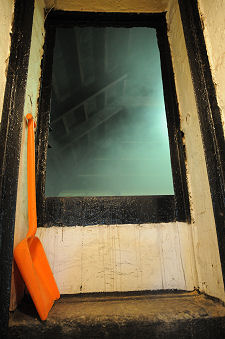
And in some cases it is possible to get a brief glimpse of the malted barley actually drying in the kiln. We say "brief glimpse" because the atmosphere inside the drying area of a kiln is invariable very smoky; invariably very hot (the aim is to heat the malted barley to a temperature that varies between 45°C and 75°C within the kiln); and usually very humid, depending on the point in the drying process the malt has reached.
 Feeding the Furnace at Laphroaig with Peat |
|
|
|
Making Malt Whisky: |
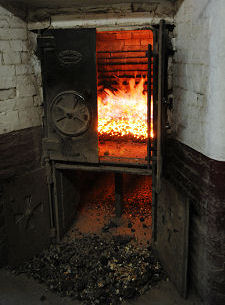 Furnace at Balvenie |
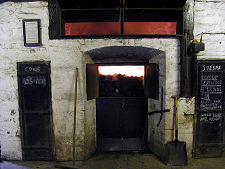 Furnace at Highland Park |
 Furnace at Laphroaig |
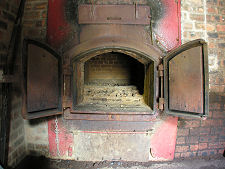 Unlit Furnace at Springbank |
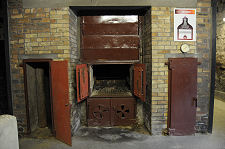 Disused Furnace, Glendronach |
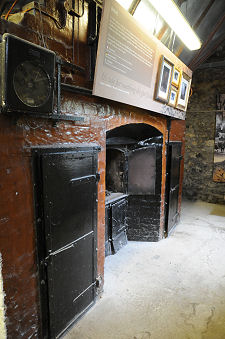 Disused Furnace, Glen Garioch |